
E-Business vs E-Commerce: Key Differences With Examples
E-business and e-commerce are often used as if they mean the same thing, but they do not. E-commerce is about buying and selling online. E-business is the wider idea of running a business with digital tools, which includes e-commerce but also covers everything behind it: managing suppliers, stock, customers, staff, finance and communication electronically.
Knowing the difference helps you plan where to invest. A new online shop needs a strong store and checkout first, while a growing company often gains more from connecting its internal systems. This guide explains both terms with examples, compares them side by side and shows how to decide what your business needs next.
E-business vs e-commerce in one sentence
E-commerce is the online buying and selling of goods and services; e-business is the use of digital technology across all of a company’s activities, of which e-commerce is one part. Every e-commerce company is an e-business, but not every e-business sells online.
What is e-commerce?
E-commerce (electronic commerce) covers transactions in which goods or services are ordered over the internet or another computer network. Buying shoes from an online store, booking a hotel room through an app or ordering office supplies through a supplier’s web portal are all e-commerce. The customer browses, chooses, orders and usually pays online, and the seller then delivers the product or provides the service.
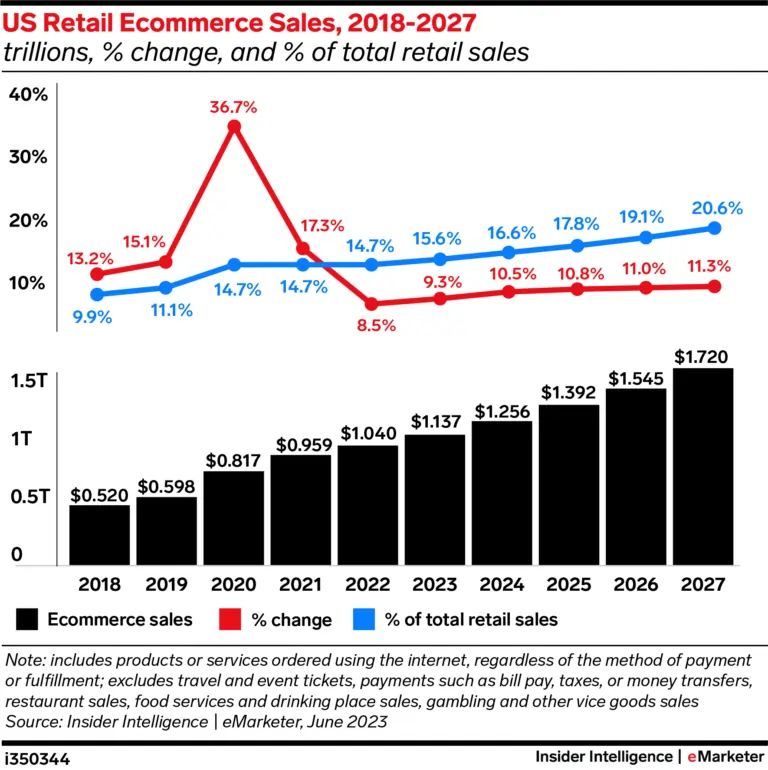
E-commerce has become a large share of retail. The chart below shows one industry forecast of US retail ecommerce sales. For official, regularly updated figures, the U.S. Census Bureau publishes quarterly estimates of retail e-commerce sales and their share of total retail sales.
Main types of e-commerce
E-commerce is usually grouped by who is selling to whom:
- B2C (business to consumer): a company sells directly to shoppers, for example a clothing brand’s online store or a large online retailer.
- B2B (business to business): one company sells to another, often in larger quantities, through wholesale marketplaces, supplier portals or online catalogs with account pricing.
- C2C (consumer to consumer): individuals sell to each other through platforms such as eBay, Etsy or Facebook Marketplace, which take care of listings and, in many cases, payments.
- C2B (consumer to business): individuals sell products or services to companies, such as a freelance designer selling work through an online platform or a photographer licensing images to brands.
- B2G and C2G (business or consumer to government): businesses bid on public contracts through online procurement portals, and citizens pay taxes, fees and fines online.
Newer forms: m-commerce and social commerce
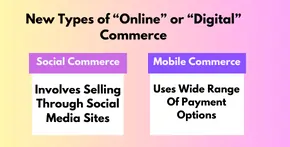
Mobile commerce (m-commerce) is e-commerce carried out on smartphones and tablets, through mobile websites, shopping apps and mobile wallets. Social commerce is buying and selling directly inside social platforms, such as shops and product tags on Instagram, Facebook or TikTok. Both are subcategories of e-commerce: the channel is different, but the activity is still an online sale.
What is e-business?
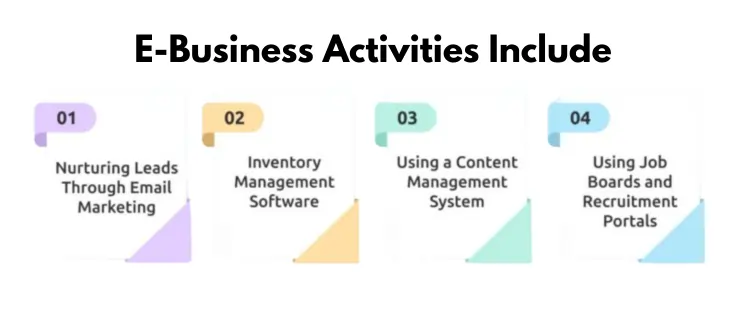
E-business (electronic business) means running business processes with digital technology. It includes selling online, but it also includes the internal and partner-facing work that keeps a company going. Typical e-business activities include:
- Customer relationship management (CRM): keeping customer records, sales pipelines and support history in one system.
- Supply chain and inventory: ordering from suppliers electronically and tracking stock with software that sends low-stock alerts. Our overview of ecommerce inventory management software shows what these tools do.
- Enterprise resource planning (ERP) and accounting: linking finance, purchasing and operations so data is entered once and shared.
- Marketing and communication: email marketing, content management systems, online collaboration and video meetings.
- Human resources: online recruitment, digital onboarding, payroll and self-service portals for staff.
A consulting firm that never sells anything online can still be an e-business if it runs its client management, billing, project tracking and communication on digital systems. Its customers might sign contracts and pay invoices offline, yet most of its operations are electronic.
Pure-play and brick-and-click businesses
Businesses that use digital channels are often described in two ways. A pure-play business operates only online, such as a software-as-a-service company or an online-only retailer. A brick-and-click business combines physical locations with online channels, for example a retailer with stores where people try products on and a website where they can order at any time, often with options like buying online and picking up in store.
Key differences between e-business and e-commerce
The table below sums up the main differences. They are tendencies rather than strict rules, because the two overlap in most real companies.
| Aspect | E-commerce | E-business |
|---|---|---|
| Definition | Buying and selling goods or services online | Running business processes with digital technology |
| Scope | Narrower: one part of e-business | Broader: includes e-commerce and internal operations |
| Main focus | Sales, payments, customer shopping experience | Efficiency, collaboration, data and the whole value chain |
| Who is involved | Mainly the seller and its customers | Customers, suppliers, partners, employees and others |
| Processes | Mostly external (customer-facing) | External and internal |
| Typical systems | Online store, marketplace, payment gateway, shopping cart | CRM, ERP, supply chain software, intranet, HR and accounting tools |
| Networks used | Mainly the public internet | Internet, plus intranets and extranets for staff and partners |
| Example | A shopper orders headphones from an online store | The same store’s stock system automatically reorders from the supplier and updates accounting |
| Key metrics | Conversion rate, average order value, revenue | Process cost, cycle time, customer retention, overall growth |
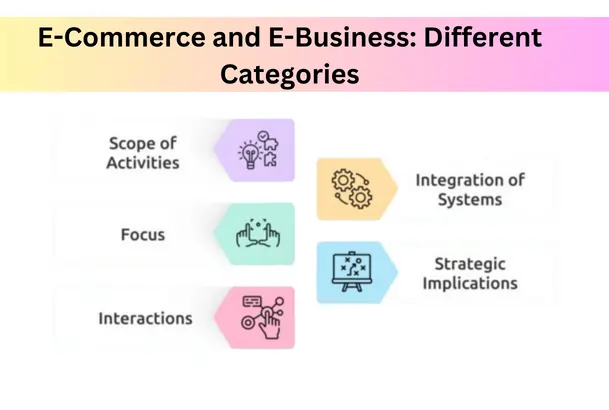
Scope and focus
E-commerce concentrates on the moment of sale: product pages, search, cart, checkout, payment and delivery updates. Success depends on a smooth, trustworthy shopping experience. E-business looks at the whole organization and asks how digital tools can make every step faster, cheaper and better connected, which in turn improves the customer experience.
Interactions and systems
E-commerce interactions are mostly transactional and short: a customer finds a product, pays and receives it. E-business interactions are wider and ongoing, such as sharing forecasts with suppliers, coordinating with logistics partners and giving employees shared access to data. That is why integration matters more in e-business. When the store, inventory, accounting and CRM systems exchange data automatically, staff spend less time re-entering information and make fewer errors.
Strategy
An e-commerce strategy aims to bring in traffic, convert visitors and increase order value. An e-business strategy aligns technology with long-term goals such as lower operating costs, better customer relationships and easier scaling. A company can have a great online store and still struggle if orders are processed by hand behind the scenes.
Real-world examples
- Small online shop: a seller runs a store on a hosted platform and takes card payments. This is e-commerce. When the seller adds inventory software, an email platform and accounting tools linked to the store, the business becomes a fuller e-business.
- Local accounting firm: it sells nothing online, but uses cloud accounting, a client portal for documents and e-signatures. This is e-business without e-commerce.
- Manufacturer: it receives orders from retailers through a B2B portal (e-commerce) and uses ERP and supply chain software to plan production and buy materials (e-business).
- Large online marketplace: customer orders are e-commerce, while warehouse robotics, demand forecasting, seller tools and internal systems are e-business.
Which should your business focus on?
It is not a choice of one over the other. The right next step depends on where your business is:
- If you want to start selling online, focus on e-commerce first: a clear, fast store, good product pages, secure payments and reliable delivery. Our guide to ecommerce website development in 10 steps walks through the process.
- If sales are growing but operations feel chaotic, invest in e-business systems: inventory, order management, CRM and accounting that talk to each other. Our article on ecommerce automation shows which tasks to automate first.
- If you do not sell products online, e-business tools can still save time and improve service, from online booking and digital invoicing to shared project tools.
Whatever you choose, plan for security and privacy from the start. Online payments, customer data and connected systems need strong passwords, access controls, regular updates and compliance with the payment card and data protection rules that apply to your business.
Frequently asked questions
Is e-commerce a part of e-business?
Yes. E-commerce is the selling and buying part of e-business. E-business also includes internal processes such as supply chain management, CRM, HR and accounting carried out with digital tools.
Can a company be an e-business without selling online?
Yes. A firm that manages clients, projects, billing and communication digitally is an e-business even if every sale is agreed offline.
What is the difference between e-commerce and m-commerce?
M-commerce is e-commerce done on mobile devices, through mobile websites, apps and mobile wallets. It is a subset of e-commerce, not a separate concept.
Is Amazon an e-commerce or e-business company?
Both. Its online store and marketplace are e-commerce, while its logistics network, seller tools, cloud services and internal systems are examples of e-business.